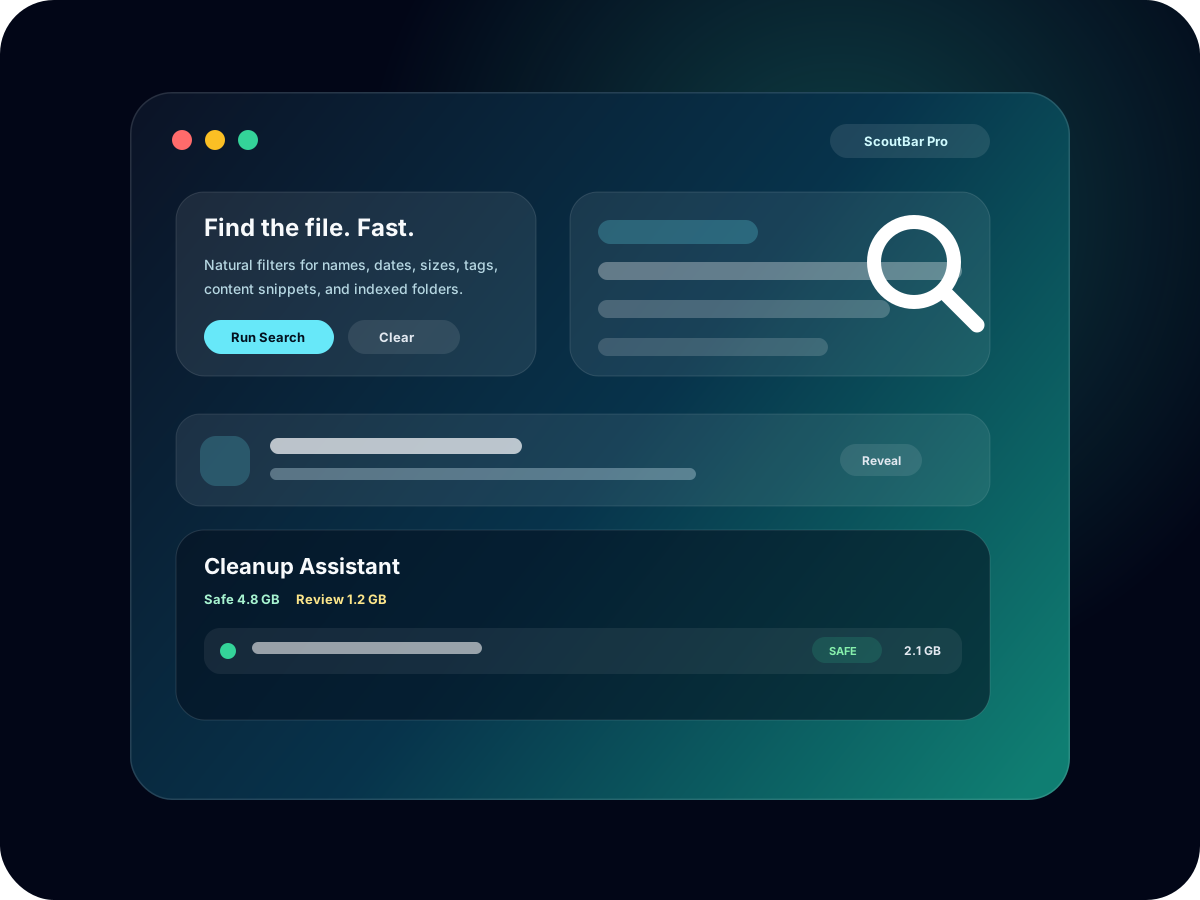
Name, extension, folder, min/max size, created or modified date window, Finder tags, content phrase. Build it visually, write it as a boolean expression, or let the visual blocks compile to text for you.
Native macOS · Coming to the Mac App Store
Find the filewithout the hunt.
ScoutBar is the Mac menu bar utility for the file you know exists — the contract from last spring, the PDF with that one paragraph, the folder full of forgotten downloads quietly eating your disk. Filter by name, content, size, date, tag, or hybrid boolean queries. Browse disk usage in a treemap. Trash bloat with one confirmation. Everything stays on your Mac.
No tracking · No account · No cloud upload of your files · One-time Pro unlock, never a subscription.
Native SwiftUI
Local indexing
Apple Silicon + Intel
Trash-safe cleanup
At a glance
What is ScoutBar?
ScoutBar is a native Mac menu-bar utility for finding files by name, metadata or text inside supported documents. It also maps disk usage and moves reviewed cleanup items to Trash; its index and file content stay on the Mac.
- Platform
- macOS 13 Ventura or later; Apple silicon and Intel
- Best for
- Finding half-remembered files, understanding disk usage and reviewing cleanup
- Processing
- Chosen folders are indexed and searched locally
- Availability
- Pre-release; Mac App Store listing not yet live
Product facts reviewed against the current application repository on . See the verification method and corrections policy.
Why ScoutBar
Spotlight gave up. So did you. Try one more thing.
ScoutBar is built for the moments where a file is hard to surface with a filename-only lookup. Three patterns shape the current build:
The half-remembered file
"It was a PDF. From spring. Something about invoicing."
Combine an extension, a content phrase, and a date window in one query. ScoutBar shows you the snippet inline, so you can pick the right one without opening five.
The disk that just won't shrink
"My Mac says I have 8 GB left and I don't know why."
Switch to the disk explorer, see your folders as a treemap or sunburst, drill into the offender, and review caches and build artifacts with explicit safe / review / blocked labels.
The "is this safe to delete?" anxiety
"I'm not deleting anything from Library/. I'll just buy a bigger SSD."
The cleanup assistant only auto-selects items it explicitly classifies as safe. Risky paths are blocked outright. Every action goes to Trash with a confirmation that shows the size and first items.
How it differs
ScoutBar versus the other launchers.
Spotlight, Alfred, and Raycast are excellent at fast app launching and clipboard tricks. ScoutBar is the one designed for the long-tail file lookup — by what's inside the document, with a treemap to follow when the disk is full.
Capability
ScoutBar
Spotlight
Alfred
Raycast
Search inside PDF & DOCX content
Yes
Limited
Add-on
No
Hybrid boolean queries with a visual builder
Yes
No
No
No
Disk usage treemap & sunburst
Yes
No
No
No
Trash-safe cleanup with safe / review / blocked labels
Yes
No
No
No
Refuses to index credentials (.env, .ssh, .pem)
Yes
No
No
No
Local-only, no account, no telemetry
Yes
Yes
Yes
With opt-out
One-time price, never a subscription
Yes
Free
Yes
No
Comparison is based on publicly documented features of Spotlight (macOS 14), Alfred 5 PowerPack, and Raycast Pro as of 2026. Trademarks belong to their respective owners.
Everyday Mac power
A calmer way to search, inspect, and clean up.
ScoutBar is not trying to replace Finder. It is the little command center you open when Finder is too visual, Terminal is too much, and Spotlight is too vague. Search by the details you actually remember, then act on the result with confidence.
Indexed search reads inside PDF, DOCX, and text files. The matching phrase is highlighted in a snippet, so you can identify the right document without opening anything.
Switch between list, treemap, and sunburst views. Drill into oversized folders, generated build artifacts, and the downloads that quietly grew legs since you last looked.
Safe / review / blocked classification on every candidate. Bulk Move to Trash always confirms, lists what it will move, and never permanently deletes. You can always restore from Trash if you change your mind.
ScoutBar indexes only the folders you choose, stores everything locally, and refuses to index secret material like .env, .ssh/, AWS credentials, or private keys.
One click on the menu bar icon. Search. Reveal in Finder. Close. A utility should earn its menu bar slot every time it appears — this one does.
Who uses ScoutBar
Built for people who keep their work on their Mac.
Developers
Find that one config file by content phrase across a year of repos. Hunt down build artifacts and node_modules graveyards.
Writers & researchers
Locate a quote across hundreds of PDFs, Markdown notes, and DOCX drafts — without leaving the menu bar.
Designers
Hybrid queries by extension, tag, and size to surface the right asset out of thousands of exports.
Founders & consultants
Find the contract, the invoice, the deck — by what's inside it — and reveal it straight in Finder in seconds.
A closer look
Designed for the menu bar, sized for the work.
Every screen below comes from the current ScoutBar Mac build.

Filter by name, extension, content, and date. The matched phrase is highlighted in the result row.

Drill into the actual offender. Sunburst view is one click away.

Compose visually or write the expression — both produce the same query.
Honest pricing
Launch plan: a free core and one-time Pro.
The repository currently plans fast metadata search at no cost, with content search, hybrid queries, the disk explorer, and the cleanup assistant in a one-time Pro unlock. The live Store sheet will control the final offer.
ScoutBar Free
Planned free core
Fast file search in your menu bar.
- Search by name, extension, folder, size, dates
- Spotlight scope across "This Mac"
- Reveal in Finder, native shortcuts
- Private by default — no account, no tracking
ScoutBar Pro
Planned one-time unlock
TBA at Mac App Store launch
The current repository plan is one in-app purchase, subject to the live Store sheet.
- Content search inside PDF, DOCX, and text files
- Hybrid boolean queries (visual + manual builder)
- Disk usage explorer — list, treemap, sunburst
- Cleanup assistant with safe/review/blocked review
- Indexing controls — Lean, Balanced, Power modes
- Finder tag filtering and metadata rules
Private by design
What stays on your Mac, stays on your Mac.
What ScoutBar does
Works only with files and folders you explicitly grant access to. Access is stored through macOS security-scoped bookmarks. The search index lives on the device.
- Local-only search index, on your Mac.
- No account required to use the app.
- StoreKit handles Pro unlock through Apple.
What ScoutBar does not do
The app does not collect analytics, run ad SDKs, or upload your files. It refuses to index obvious secrets (.env, .ssh/, private keys, AWS credentials) even if you accidentally point it at them.
- No tracking, no ads, no third-party analytics.
- No cloud upload of file names, paths, snippets, or document text.
- No call-home telemetry in the documented sandboxed release build.
Common questions
Before you commit.
How is ScoutBar different from Spotlight?
Spotlight is the sensible built-in choice when you remember the name. ScoutBar is for cases where you instead remember a phrase inside the file, a rough date, its size, its folder or a Finder tag. You can combine those filters in one query and review content snippets in the results.
Does ScoutBar send my files to the cloud?
No. ScoutBar indexes only folders you choose, stores the index on your Mac, and never uploads file names, paths, content snippets, or document text to HighRoad Software. There is no account, no telemetry, and no advertising SDK.
What does ScoutBar Pro unlock?
The current launch plan puts content search inside PDF, DOCX, and text files; hybrid Boolean queries; the disk usage explorer; the cleanup assistant; and full index controls in Pro. The planned free core covers fast metadata search and Spotlight scope. The live Store sheet will confirm final scope.
Is ScoutBar Pro a subscription?
The repository plan is a one-time Apple in-app purchase rather than a subscription, with Restore Purchases built in. The live Store sheet will confirm the final commercial terms.
Can ScoutBar accidentally delete a file?
Cleanup actions always go to Trash, never permanently delete, and always show a confirmation dialog with the size and first items. Risky paths are blocked outright; review-level paths are never auto-selected.
Will ScoutBar work on my Mac?
ScoutBar targets macOS 13 Ventura and later on both Apple silicon and Intel Macs. The sandboxed Mac App Store build is still being prepared and its public listing is not live.
Does ScoutBar index my whole disk?
No. You explicitly choose which folder ScoutBar indexes; everything else is searched live or via Spotlight. You can switch between Lean, Balanced, and Power indexing modes, and FTS/cache budgets are configurable.
What about secret files like .env or SSH keys?
ScoutBar explicitly refuses to read or index files with names or paths that look like credentials: .env, .netrc, id_rsa, .aws/, .ssh/, .gnupg/, .pem, .key, .p12, and similar — even if they happen to be inside a folder you indexed.
From the same studio
Other macOS apps from HighRoad Software.
The team behind ScoutBar also makes a private document-research app, a market-research desk, and a multi-agent thinking surface. Each product page states its own processing model, release channel, and current commercial status.
Launch status
Coming to the Mac App Store.
ScoutBar is being prepared for release. Leave your email and we'll send a single message the day the Mac App Store listing opens — and nothing else.
One email at launch. No newsletter, no tracking pixel, no sharing — your address opens your mail client and goes straight to support@highroadsoftware.com.