
LumenForge · macOS · Apple Silicon
Generate images.
On your Mac.
In a real Mac app.
Run compatible Stable Diffusion, FLUX, Wan video, and other model families with Metal acceleration. The runtime ships with the app; your prompts and outputs stay in your local workspace.
macOS 13 or later · Apple Silicon (M1+) · No account required
At a glance
What is LumenForge?
LumenForge is a native Mac workspace for generating images and video with compatible local models, including FLUX, Stable Diffusion and Wan workflows. Prompts and generation stay on the Mac after the user obtains the models and optional components they choose.
- Platform
- macOS 13 or later; Apple silicon; 16 GB RAM minimum
- Best for
- Private image and video generation with user-selected local models
- Processing
- Generation runs locally with Apple-silicon acceleration
- Availability
- Beta; current signed-build availability confirmed on request
Product facts reviewed against the current application repository on . See the verification method and corrections policy.
A Mac studio, not a browser panel.
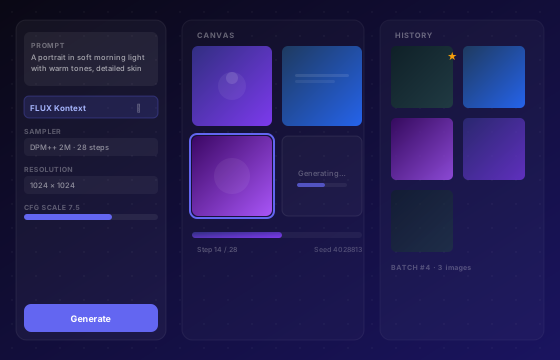
These are current LumenForge screens: the main generation workspace, video mode, and the local image browser.


Everything you need
to generate at full power
Most local image tools ask you to configure Python environments or tolerate web-based UIs. LumenForge is a proper macOS app that handles everything — from model detection to Metal GPU routing — so you can focus on generating.
Generation Engine
Every parameter, nothing hidden
Text to image. Image to image. Inpainting. All in the same workflow. The controls are full-featured without being overwhelming: sampler selection, step count, CFG scale, resolution up to 8192px, seed locking, batch generation, custom VAE override. Simple Mode is there if you want fewer knobs — full mode when you need them all.
- 10+ samplers: Euler, DPM++ 2M/SDE, DDIM, UniPC, LCM, and more
- Inpainting with a native mask editor — paint directly on your image
- Batch generation with seed variation or fixed seed across a run
- CFG scale 0–50, steps 1–200, CLIP skip 1–12
- Tiled VAE for large resolution outputs without memory errors
- Custom VAE override per generation
Model Ecosystem
18+ architectures. Three inference engines.
The current repository contains adapters for the model families listed below and routes recognised files to a compatible inference engine. A safetensors file may use Diffusers or mflux; supported GGUF files use stable-diffusion.cpp with Metal; compatible MLX archives use Apple-silicon inference. Compatibility still depends on the exact architecture, quantisation and build, so an unknown model is not presented as universally supported.
- FLUX dev, schnell, Kontext — state-of-the-art image quality via mflux
- SDXL and SD 1.5 — broad LoRA ecosystem, fast iteration
- Wan 2.2 and LTXV — text-to-video and image-to-video, local
- GGUF quantized models — run large models (4-bit, 8-bit) on less RAM
- MLX format — Apple Silicon native, fast and memory-efficient
- Chroma, Lumina 2, Qwen Image, ERNIE, Z-Image, and more
Edit Mode & Advanced Workflows
Reference images, ControlNet, LoRA, video
Edit Mode — available on FLUX Kontext, FLUX 2, Qwen, and Z-Image — lets you generate using reference images as visual anchors. The model attends to your references rather than blending them, so you get coherent outputs even when the prompt pushes in a new direction. For structure control, ControlNet guides generation with Canny edges, depth maps, or pose estimation.
- Edit Mode: reference-conditioned generation, up to multiple input images
- ControlNet: Canny edge, MiDaS depth, OpenPose preprocessors
- LoRA blending: load multiple LoRAs, adjust per-weight strength
- Wildcards: define variable prompt lists for batch variation
- Video: T2V and I2V with Wan 2.2 and LTXV — queue overnight, no timeout
- Prompt Enhancer: expand prompts locally with Ministral-3 (optional)
Privacy & Architecture
Your Mac, your models, your images
LumenForge ships a full Python 3.11 runtime inside its app bundle. When you open the app, the backend starts on your machine and listens on localhost — nowhere else. There is no LumenForge server. Your prompts, your model files, your generated images: none of it goes anywhere you didn't put it yourself.
- Bundled Python 3.11 — no pip install, no conda, no setup scripts
- Backend communicates over localhost only — App Sandbox enforced
- No account, no login, no telemetry of any kind
- Models you download once work forever — no expiry, no API policy changes
- All generation history stays in ~/Library/Application Support/LumenForge
- Native Mac interface with a bundled, isolated runtime
Up and running in three steps
No Python installation. No virtual environment. No shell scripts. One download, and you're generating.
Install LumenForge
Install the signed beta build supplied through the current release channel. The app bundle includes the runtime and inference dependencies, so you do not need to assemble a Python environment first.
Add your models
Download model files from Hugging Face or Civitai and place them in your models folder. LumenForge scans on launch, reads the metadata, and detects the architecture and format automatically — safetensors, GGUF, or MLX. No manual configuration required.
Generate
Write a prompt, pick a model, set your parameters, and hit Generate. Results appear in the canvas. Every image is saved to your history automatically. Use workspaces to keep separate projects organised — portraits, landscapes, a specific client brief — without mixing their histories or settings.
Core runtime stays lean.
Add what you need.
Optional capability packs extend the core generation engine. Their availability and download path depend on the signed build you receive.
ControlNet Preprocessors
Canny edge, MiDaS depth, and OpenPose preprocessors for guided generation. Give the model a structure to follow — useful for consistent composition, character poses, and architectural layouts.
SD 1.5 & SDXLAI Upscaler
RealESRGAN 2x and 4x upscaling for any generated image, with optional GFPGAN face enhancement. Runs locally — no cloud API, no file uploads. Upscale portraits and landscapes to print-ready resolution in seconds.
All modelsPrompt Enhancer
Runs Ministral-3 locally to expand and refine your prompts before generation. Useful when working with ERNIE Image models, or when you want the model to fill in craft details you haven't specified.
ERNIE & compatibleAll packs run entirely on your machine. None of them send data anywhere.
Common questions
Your Mac can do this.
It just needs the right app.
LumenForge is in release validation. Ask for the current signed build and its exact capability-pack, pricing, and hardware details.
Requires macOS 13 or later · Apple Silicon (M1+) · 16 GB RAM minimum